




Fish vs Poultry Pet Food: Heavy Metals Compared
The pattern across studies, the exceptions, and what to ask about your recipe.
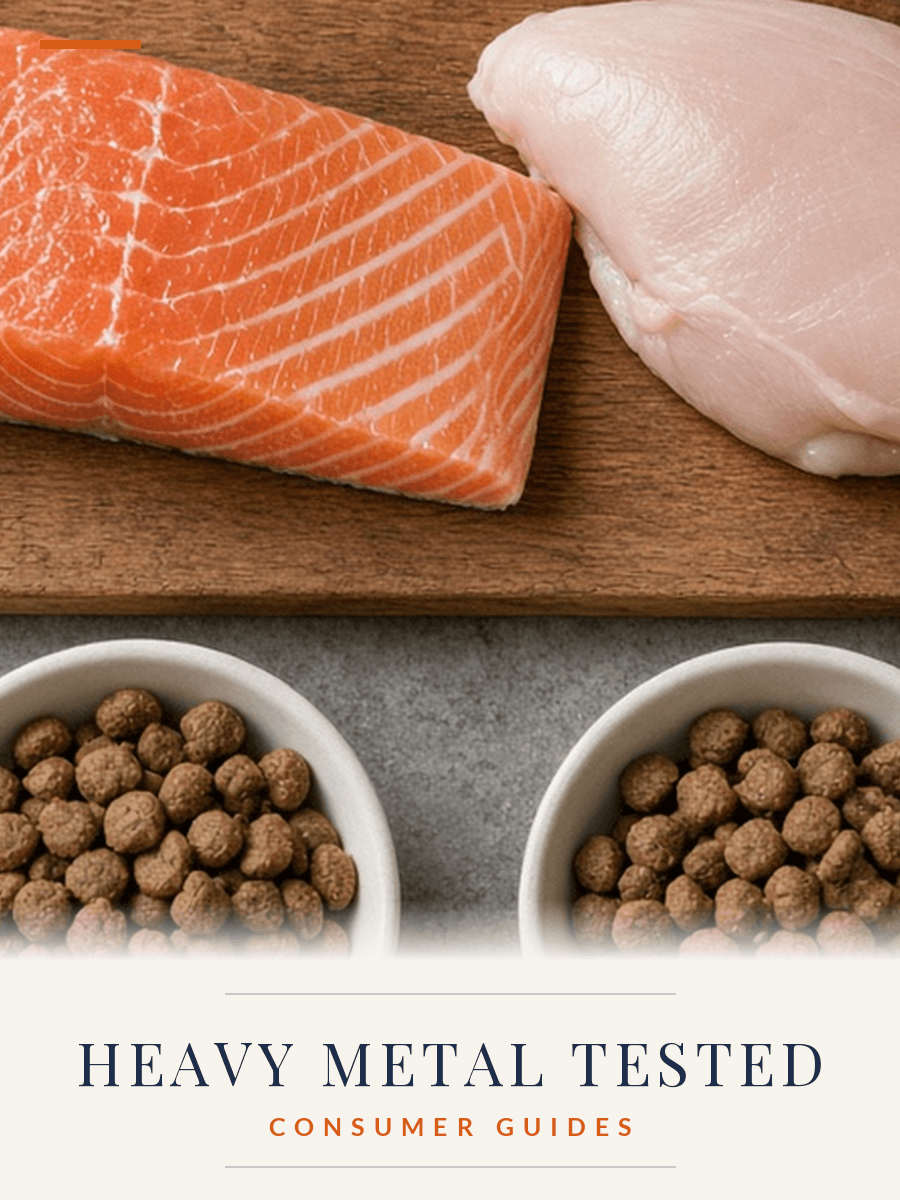
Is fish or poultry pet food higher in heavy metals? What cat and dog food studies found by protein, why no protein always wins, and what to ask.

Abstract
Keywords
fish vs chicken cat food heavy metals, is fish cat food high in mercury, poultry vs fish dog food heavy metals, salmon cat food mercury

The short answer
In the two studies we reviewed that compared finished foods by protein for mercury and arsenic, from the US and Spain, fish-based foods ran higher in both, and in cadmium. A Turkish study also found more cadmium in fish and red meat foods than in poultry foods. Poultry-based foods were often lower, but not in every study, and in one dog food study red meat foods had more lead.
That's a pattern across groups of foods, not a verdict on your pet's recipe. Two fish recipes can differ a lot, and one study ranked poultry above fish. The useful step is to ask about the recipe you feed, and to talk with your vet before you change it.

What the studies compared
Each study below looked at different foods, in different countries, with different methods. Here's what each found when it compared protein sources.
US dry dog foods, 2018. A study of 51 dry dog foods, 17 built on each protein, found that fish-based foods had significantly higher arsenic, cadmium and mercury than poultry or red meat foods, while red meat foods had higher lead. Our post on heavy metals in dog food covers it in more depth.
Spain, cat foods, 2021. In a study from Spain of dog and cat foods, fish-based cat foods had significantly higher median arsenic, cadmium and mercury than meat-based cat foods. The researchers could only make this comparison in cat food, because just two of the dog foods were fish-based. They concluded that the food's composition, not its price, seemed to shape its contaminant profile.
Turkey, dry cat foods, 2026. A study of dry cat foods built on poultry, fish or red meat found cadmium significantly higher in the fish and red meat foods than in the poultry foods. Copper and iron, which are nutrients, were higher in the poultry foods. According to the abstract, all measured metals stayed below established regulatory limits, though copper, a nutrient, exceeded an industry recommended limit in some diets. In the cats eating these foods, the authors saw no consistent build-up by protein source or by how long the cats had been fed. They caution that their design can't rule out long-term risk. Our post on cadmium in cat food covers that metal in more depth.
South Africa, cat and dog foods, 2025. A study of extruded cat and dog foods found that red meat formulations had the highest total heavy metal levels, followed by poultry, fish and meat medley formulations. Here, fish was not the highest.
Brazil, ingredients, 2021. A study that tested pet food ingredients as well as finished foods found that, among the protein ingredients, beef meal and chicken by-products had the highest mercury. No fish meal sample had mercury above the detection limit. Our post on lead, arsenic, and mercury in cat food explains what its authors made of that.
Why fish stands out
Mercury is the clearest reason. As background from human food, the FDA says nearly all fish and shellfish contain trace amounts of methylmercury, and that eating seafood is the most common way people in the US are exposed to mercury. A 2016 study of mercury in cat and dog food explains in its abstract that mercury concentrates in fish and that fish is an important pet food ingredient. Its authors assumed the mercury in pet food was mostly methylmercury, but said this still needs to be tested.
Arsenic adds a wrinkle. It comes in organic and inorganic forms, and as human food background, the FDA says current research indicates inorganic arsenic is more dangerous than organic. A total arsenic result doesn't show the form. Our post on lead, arsenic, and mercury explains why form matters.
Fish meal is one of several sea ingredients. Sea ingredients get their own post.
Why poultry isn't automatically lowest
It's tempting to read the fish results and conclude that poultry is always the low option. The studies we reviewed don't support that.
In the South African study, poultry formulations ranked second, above fish. The Brazil ingredient results above point the same way for mercury.
Poultry did come out relatively lower in several studies. The US dog food authors described poultry-based diets as relatively lower overall, and in the Turkey study, cats fed poultry diets had lower blood lead than the other groups, with every group within reference ranges. But "often lower" isn't "always lowest." Studies describe groups of products, not the bag in your pantry.
Format is a separate question, which our post on wet vs dry pet food covers. Our post on where heavy metals in cat food come from explains how metals get into fish and meat in the first place.
What this means at the bowl
If your cat loves a fish recipe, that's where it's most worth asking questions, not a reason to panic. Our guide to how to check cat food for heavy metals includes finding the main protein.
Ask the brand, recipe by recipe:
- Which metals do you test this recipe for?
- Are results total metal, or do you test the form of mercury or arsenic?
- Are results reported as fed or on a dry matter basis?
- Can you share recent results for this recipe?
Our guide on how to read pet food heavy metal test results helps with the answers. And if you're thinking about changing proteins, talk with your vet first. A diet change is about more than metals.
FAQ
Is fish cat food higher in mercury? In the two studies we reviewed that compared finished foods by protein for mercury, from the US and Spain, fish-based foods were higher. In the Brazil ingredient tests, though, no fish meal sample had mercury above the detection limit, while beef meal and chicken by-products had the highest.
Is chicken cat food lower in heavy metals? Often, but not in every study. Poultry foods were lower for cadmium in the Turkey study and relatively lower overall in the US dog food study, but ranked above fish in the South African study.
Should I stop feeding my cat fish? Not automatically. Ask the brand about the specific recipe, and talk with your vet before changing your cat's diet.
Does red meat matter? It can. In the 2018 US dog food study, red meat foods had higher lead, and in the South African study, red meat formulations had the highest total heavy metal levels.
A note on your pet's health
This article is general information, not veterinary advice. Talk with your veterinarian before changing your pet's diet.
Protein is a clue, not a result
Heavy Metal Tested is a certification program that helps brands share independent results with owners. Learn how certification works.
Case Studies You May Be Interested In
 Wet vs Dry Pet Food: What Changes for Heavy Metals
Why there is no simple winner, and what to ask instead.
October 26, 2026
 "Low in Heavy Metals" on a Pet Food Label: What It Means
Who checks the words on the bag, and how to make a claim checkable.
October 25, 2026