



What's in Your Cat's Food? A 5-Minute Heavy Metals Check
A calm, practical way to check what's in your cat's bowl.

Wondering about heavy metals in cat food? Use this 5-minute check, learn what to ask your cat food brand, and know when to talk to your vet.

Abstract
Keywords
heavy metals in cat food, cat food heavy metals check, what's in my cat's food, cat food certificate of analysis, mercury in fish cat food, cat food testing

Trace amounts of heavy metals are nearly always present in pet food, so the real question is how much is there and whether the food is tested. That's not a reason to panic. According to the FDA's report on heavy metals in animal food, metals such as arsenic, lead, cadmium, and mercury are found in the air, water, and soil, so removing them entirely from animal food isn't always possible. The FDA monitors heavy metal levels in animal food and pet food ingredients for exactly that reason.
If you've been looking at your cat's bowl and wondering what's in it, you're not alone, and you're not out of options. You can't run a lab test in your kitchen, but you can find out a lot about what your cat eats in about five minutes. You also don't need to switch foods tonight.
What matters is how much, how often, and whether the company making the food actually measures it. A label can't tell you that on its own. A few good questions can.
Should I switch my cat's food right away?
Not without a reason. A food you grab in a hurry isn't automatically better tested than the one you already buy, so it helps to gather the facts first and then decide. If you're thinking about a change, ask your vet before switching foods. They can help you pick a new food and plan the change in a way that suits your cat.
The 5-minute check
1. Note every type of food your cat eats
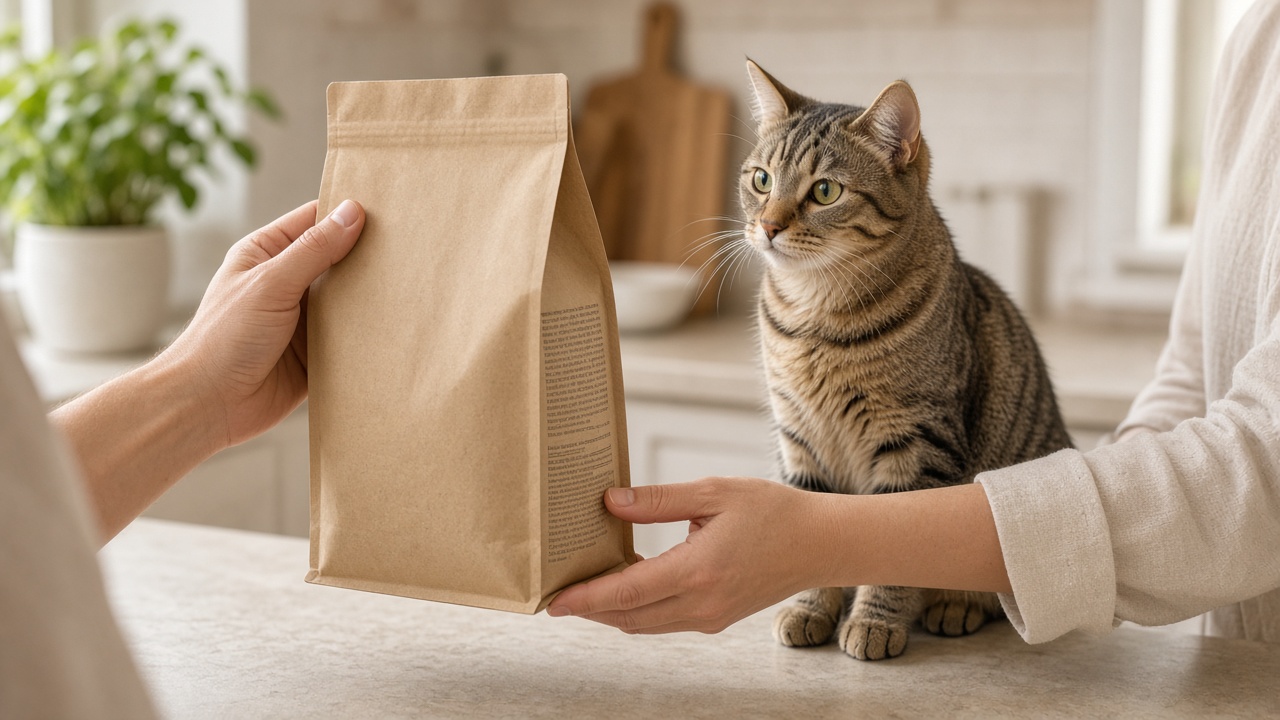
Write down the wet food, dry food, fresh or raw food, treats, and toppers. Each is made from different ingredients, so each is worth checking. Treats and toppers are easy to forget, but they're part of what your cat eats too. A varied diet also means your cat isn't relying on a single product all day, every day.
2. Find the main protein
Look at the first few ingredients. Ingredients are listed from most to least by weight, so the first few tell you what the recipe is mostly made of. If the recipe is built on fish, give it a closer look. The FDA notes that seafood is the most common way people are exposed to mercury, and that nearly all fish and shellfish contain trace amounts of it. That doesn't make fish recipes bad. It makes them the ones to ask about first.
3. Scan the rest of the ingredient list
Some ingredients, like fish meal, seaweed, and kelp, come from the sea, so they're worth asking about. They're common and often useful, so there's no need to avoid them. Just add them to your list of questions.
4. See whether the company publishes test results
Open the brand's website and search for "heavy metals" or "testing." Real information names the metals tested, says how often testing happens, and shows results. A line like "we follow strict quality standards" with nothing behind it doesn't tell you much. If you can't find anything, that's not proof of a problem. It just means the next step is to ask.
5. Ask for a Certificate of Analysis
A Certificate of Analysis, or COA, is a lab report for a specific batch of product. Ask whether the company can share one that covers heavy metals and which lab ran the tests. If you get one, our guide on how to read a heavy metal COA walks you through it line by line.
That's it. You now know what your cat eats, which ingredients deserve a question, and whether the company is willing to show its numbers. Keep your notes somewhere handy, since you'll want them for the next two steps.
Who checks pet food in the US?
In the US, the FDA enforces pet food laws, and states regulate pet food too. You'll often see AAFCO mentioned on labels. AAFCO writes model rules that many states adopt, but it doesn't test, approve, or certify pet food itself, according to AAFCO's guide to understanding pet food. That's why a company's own published testing is so useful to owners.
A note you can send the company
Most pet food companies have a customer service email or contact form. Copy this, fill in the product name, and send it:
Hi, I feed my cat [product name]. Do you test this product for heavy metals, including lead, arsenic, cadmium, and mercury? How often do you test, which lab does the testing, and can you share recent results or a Certificate of Analysis? Thanks.
A clear, specific answer is a good sign. A vague one tells you something too. If you feed more than one product from the same company, ask about each one by name, since results for one recipe don't cover another.
When to call your vet
Your vet knows your cat's age, health history, and diet, so they're the right person to talk to if you're worried. Bring the product names and ingredient lists, plus any replies you got from the companies. Mention any changes you've noticed in your cat's appetite, energy, or behavior. Kittens, older cats, and cats with health conditions are especially worth a conversation.
This article is general information, not veterinary advice. If you're concerned about your cat's health, contact your veterinarian.
Keep reading
- Learn what third-party tested really means before you trust a claim on a bag.
- Read our guide to heavy metals in food for the bigger picture.
FAQ
Does any cat food contain no heavy metals at all? It's unlikely. Metals are found in the air, water, and soil, so ingredients usually carry some trace amounts. The better question is whether a product is tested and whether the results are shared.
Is wet or dry food better? There's no simple rule. The specific product's results matter most.
Should I avoid fish-based cat foods? Not automatically. Fish recipes are simply where it's most worth asking about testing, because seafood is the most common source of mercury exposure.
Does AAFCO test or approve pet food? No. AAFCO writes model regulations that states can adopt. The FDA and states regulate pet food.
Should my cat be tested for heavy metals? That's a question for your vet, who can decide whether it makes sense for your cat.
Look for brands that publish independent heavy metal results. Heavy Metal Tested is a certification program that helps brands show owners exactly that. Learn how Heavy Metal Tested certification works.
Case Studies You May Be Interested In
 How a Product Earns the Heavy Metal Certified Mark
One product, one independent test, one published standard, every year.
September 30, 2026
 Heavy Metals in Children's Supplements: What Parents Should Know
Ask if your child needs it first. Then check how it was tested.
September 29, 2026