



Where Do Heavy Metals in Cat Food Come From?
The main routes from farm and sea to your cat's bowl, and what to ask next.
Heavy metals reach cat food through soil, water, sea ingredients, and processing. See where they come from, who monitors them, and what to ask.

Abstract

If you've been reading about heavy metals in pet food, a natural first thought is that someone must have done something wrong. Usually the story starts much earlier than the factory. According to the FDA's report on heavy metals in animal food, metals such as arsenic, lead, cadmium, and mercury are found in the air, water, and soil, so removing them entirely from animal food isn't always possible.
The short answer
Most heavy metals in cat food come in with the ingredients. Crops take them up from soil and water. Farm animals take them in through what they eat, and that carries into meat meals and by-products. Fish and other sea ingredients pick them up from the water they live in. Added minerals and processing steps can contribute too.
So why care, if much of it is natural? Because the amount matters. The same FDA report notes that high levels can be toxic, and that small amounts from different sources could add up to a level of concern. Knowing where metals come from helps you ask better questions about how much is there, and our post on lead, arsenic, and mercury in cat food covers how each can affect cats.
Soil, water, and air
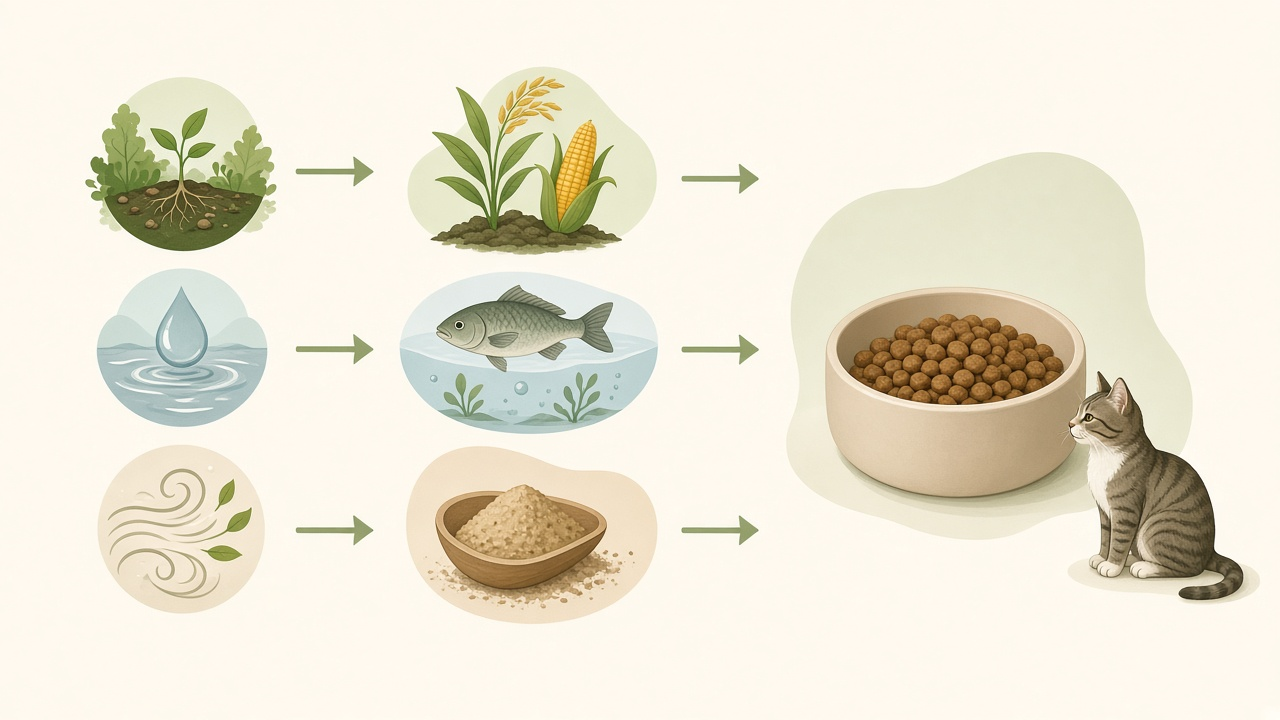
Almost every route starts in the environment. The FDA explains that levels of lead, arsenic, cadmium, and mercury vary with the natural makeup of an area and how close it is to past or present use or manufacturing of products made with those metals.
Human activity plays a big part. The FDA notes that arsenic is higher in certain soils and rocks, where arsenic pesticides were once used on food crops, and near pollution from mining and coal-fired power plants. Cadmium is higher where some phosphate fertilizers are used and near smelting, mining, and the burning of fossil fuels.
A 2021 study in Scientific Reports describes soil as the main store for these metals. It lists fertilizers, irrigation water, sewage sludge, and fallout from industry among the ways soil gets contaminated. From there, the authors note, contamination can reach farmland and farm animals whose products and by-products end up in pet food.
Plant ingredients
Many cat foods, especially dry recipes, include grains and other crops. The FDA says cadmium and lead in the environment can be taken up by plants and enter the food supply.
The Scientific Reports authors make the same point for pet food. Plant ingredients grown in contaminated soil, such as corn, rice, wheat, peas, barley, and sorghum, can build up toxic metals and add to what ends up in the bowl. In the ingredients they tested, wheat bran had the highest levels of most of the metals measured among the carbohydrate sources.
Animal and by-product meals
Cats need a lot of animal protein, so this route matters. When farm animals eat feed grown on contaminated soil, they can build up metals too. The Scientific Reports study names poultry by-product meal and meat meal as ingredients that can carry those metals into pet food.
In that study, animal by-products generally had higher metal levels than plant protein sources. Beef meal and chicken by-product meal showed the highest mercury of the protein sources tested. The authors suggest this may help explain why cat foods, which use more animal protein to meet a cat's needs, can carry more of it.
One line on why it matters: the FDA notes that in people, the body clears cadmium slowly, so it can build up in the kidneys and liver over years.
Fish and sea ingredients
Fish is the route most people already know about. The FDA says nearly all fish and shellfish contain trace amounts of methylmercury, and that it isn't possible to remove it from seafood. For people, seafood is the most common way they're exposed to mercury.
For pet food, the picture depends on the fish. The Scientific Reports authors note that mercury in fish varies with species, origin, whether it was farmed or wild, its size, and its life span. Fish meal can be made from fishery by-products or from fish caught just for that purpose. The fish meal they tested didn't show mercury above the detection limit, but it did show other metals, including lead. In the FDA's own sampling, the highest arsenic results included an imported fish meal.
Added minerals and processing
Cat food is fortified with vitamins and minerals. The FDA Pet Food page explains that added minerals must be approved or accepted by the FDA for use in animal food.
Those minerals are mined or manufactured, and they can carry metals of their own. The Scientific Reports study found high lead in the calcium carbonate and dicalcium phosphate samples it tested. In the FDA report, the highest cadmium results all came from mineral supplements and mixes, and a poultry mineral mix was among the highest results for mercury and lead.
Processing can also play a role. The FDA notes that arsenic can enter food during processing, for example when contaminated water is added.
Who monitors it
In the US, the FDA and state partners carry out risk-based inspections of pet food facilities, and federal law requires that animal food contain no harmful substances. The FDA also samples animal food and ingredients for heavy metals each year.
Its report on samples from 2015 to 2017 found most results below maximum tolerable levels for arsenic, cadmium, mercury, and lead. Some ingredients and mineral premixes were higher, but based on typical inclusion rates, the FDA expected levels in the finished feed to stay within an acceptable range. Because small amounts from different sources can add up, the FDA said it would move toward more targeted sampling.
What this means for your cat
Finding traces of heavy metals in a food doesn't mean a company cut corners. Metals come from the farm, the sea, and the mineral supply long before anyone mixes a recipe. What a company controls is where it sources ingredients and whether it tests them, and that's what's worth asking about.
If you'd like a simple way to do that, our 5-minute heavy metals check for cat food walks you through it. If you're unsure which metals count as "heavy" in the first place, see Is Iron a Heavy Metal? For the human food side, read our guide to heavy metals in food, and if a company sends you results, here's how to read a heavy metal COA.
This article is general information, not veterinary advice. If you're concerned about your cat's health, contact your veterinarian.
FAQ
Does finding heavy metals in cat food mean the company did something wrong? Not by itself. The FDA says these metals are found in air, water, and soil and can't always be removed entirely from animal food. The useful questions are how much is present and whether the company tests for it.
If metals are natural, why does it matter? Amount matters. The FDA notes high levels can be toxic and that low levels from different sources could add up to a level of concern.
Are fish recipes the only ones with heavy metals? No. Research on pet food ingredients found metals in plant ingredients, animal by-product meals, and mineral supplements as well as fish meal.
Who checks pet food for heavy metals in the US? The FDA samples animal food and ingredients for heavy metals, and the FDA and states inspect pet food facilities.
Want to know whether a brand tests for heavy metals? Heavy Metal Tested is a certification program that helps brands show owners their independent results. Learn how Heavy Metal Tested certification works.
Case Studies You May Be Interested In
 Lead, Arsenic, and Mercury in Cat Food: What We Know
For each metal: what it does, where it shows up, and how strong the evidence is.
October 14, 2026
 Is Iron a Heavy Metal? Essential vs. Toxic Metals List
Why iron on a label isn't the same as lead in a test result.
October 13, 2026