



Heavy Metals in Your Pet's Water: What Owners Should Know
Your tap and your well are two things you can check yourself.
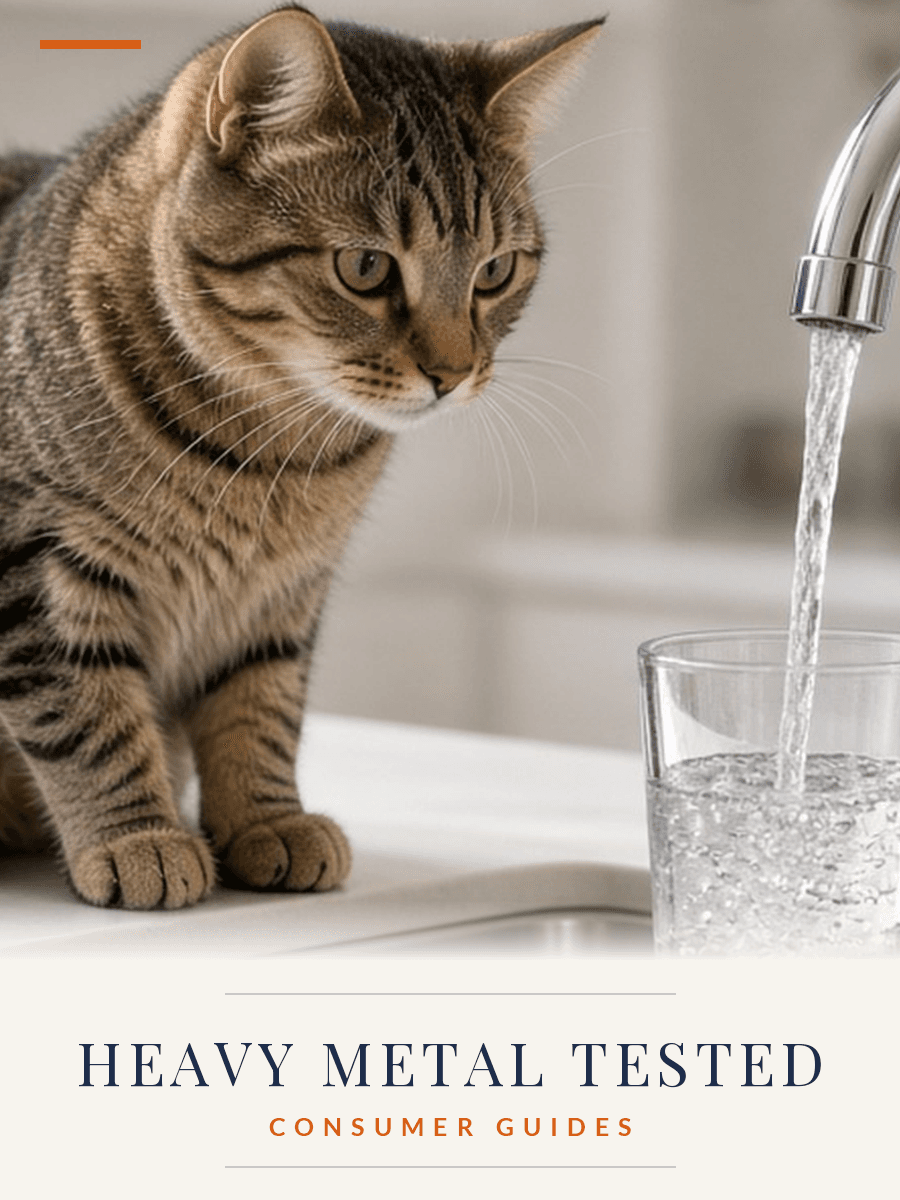
Lead and arsenic can reach pets through tap and well water. How to read your water report, check a well, cut lead at the tap and when to call your vet.

Abstract
Keywords
heavy metals in pet water, lead in pet water bowl, can pets drink tap water with lead, well water for dogs arsenic

Most of the heavy metal conversation about pets is about food. But the bowl next to the food bowl gets refilled every day, often straight from the tap. If you've been reading labels and asking brands about testing, the water is one more thing worth a look, and it's one you can check yourself.
The short answer
Food isn't the only route. Drinking water can carry lead from older plumbing, and water from private wells can carry arsenic and other contaminants. The guidance below comes from the EPA and the FDA and is written for people, but the same tap fills your pet's bowl. Two steps help: find out what's in your water, and act on what you learn. As for the bowl itself, ask what it's made of if you don't know.
Why water matters
Some researchers who study heavy metals in pets treat water as part of the picture. The abstract of a 2026 study of cats in Turkey notes that heavy metals can enter the pet food chain through animal protein ingredients and drinking water, and the researchers measured metals in household drinking water as well as in food, blood, and hair. The abstract does not report the water results, so we can't say what they found.
The sources we reviewed did not compare how much of a pet's intake comes from water versus food. What they do describe is how metals get into household water, and what you can do about it. For how metals reach the ingredients in pet food, see our post on where heavy metals in cat food come from.
Check your water: city or utility water
Start with your water utility's report. The EPA requires community water systems to prepare an annual water quality report, called a Consumer Confidence Report, for their customers. You can contact your utility for the latest copy or look it up through the EPA's find your local report tool.
Lead is also a question about your own plumbing. The EPA explains that lead can enter drinking water when plumbing materials that contain lead corrode, and that the most common sources are lead pipes, faucets, and fixtures. Where a lead pipe connects a home to the water main, called a lead service line, that pipe is typically the most significant source. The EPA says lead pipes are more likely in older cities and in homes built before 1986. In homes without lead service lines, the most common problem is brass or chrome-plated brass faucets and plumbing with lead solder.
You can't see, taste, or smell lead dissolved in water. The EPA says testing is the only sure way to know, and that your state or local drinking water authority can point you to certified labs. Your utility may also know whether your service line is made of lead.
What the EPA suggests if you're concerned about lead
These steps are written for people, but they apply to water you pour for a pet too:
- Use a filter certified to remove lead, follow its directions, and replace the cartridge on time. The EPA notes that an expired cartridge can be less effective, and that you shouldn't run hot water through the filter.
- Clean the faucet aerator, the small screen at the tip of the tap, where lead particles can collect.
- Use cold water. The EPA says boiling water does not remove lead.
- Run the tap after water has sat in the pipes for a while, since water that has been sitting may contain more lead. Your utility can tell you how long to run it.
- Ask your utility or a licensed plumber whether your service line is lead, and contact your water system and local health department with questions.
Check your water: private wells
If your water comes from a private well, the rules are different. The EPA's private well page explains that private well owners are responsible for their own water, and that private wells are not regulated by the federal government under the federal drinking water law, nor by most states. It also cites a U.S. Geological Survey study of 2,100 private wells in which about one in five wells had at least one contaminant above a human health benchmark.
For wells, the FDA points to arsenic. Its arsenic in food page, citing the World Health Organization and the CDC, says the most common source of high levels of inorganic arsenic is contaminated drinking water. Because private well water isn't routinely tested by government agencies, the FDA says well users should check their state's recommended testing schedule for arsenic and other contaminants, and contact their state drinking water well program if they suspect a problem. The EPA adds that your health department, or a nearby utility that uses ground water, may know which contaminants are a concern in your area.
For more on arsenic and why its form matters, see our post on lead, arsenic, and mercury in cat food.
Keep it in proportion
These are steps you control, and most of them are simple: read a report, test if you're unsure, maintain a filter if you use one. They don't replace questions about what's in the food. Our post on heavy metals in dog food also covers lead from outside the bowl. If your water report or a test flags lead or arsenic and you're worried about your pet, talk with your vet.
FAQ
Can lead get into my pet's water from pipes? It can. The EPA says the most common sources of lead in drinking water are lead pipes, faucets, and fixtures. Check your utility's annual water quality report, ask whether your service line is lead, and consider a filter certified to remove lead.
Does boiling water remove lead? No. The EPA says boiling water does not remove lead. It recommends using cold water and a certified filter if you're concerned.
Should I test my well water? The EPA says private well owners are responsible for their own water, and most wells aren't regulated by federal or state rules. The FDA suggests following your state's recommended testing schedule for arsenic and other contaminants.
This article is general information, not veterinary advice. If you think your pet has been exposed to lead or another metal, or is unwell, contact your veterinarian right away.
For what's in the food itself, look for brands that share independent results. Heavy Metal Tested is a certification program that helps brands share independent results with owners. Learn how Heavy Metal Tested certification works.
Case Studies You May Be Interested In
 Who Regulates Heavy Metals in Pet Food?
The FDA, the states, and AAFCO each have a different job. Here is how they fit together.
October 22, 2026
 How Is Pet Food Tested for Heavy Metals?
Who tests pet food, what a lab does with a sample, and what to ask a company.
October 21, 2026