



How to Read Pet Food Heavy Metal Test Results
Four questions that turn a number into information.
Got heavy metal results for your pet's food? How to read units, as fed vs dry matter, total vs form, and comparisons, and what one batch can tell you.

Abstract
Keywords
how to read pet food heavy metal test results, pet food heavy metals ppm, dry matter basis heavy metals, what does ND mean pet food test, pet food heavy metal levels compared

The short answer
A heavy metal number on its own says little. Four questions turn it into information:
- What's the unit?
- Is it reported as fed or on a dry matter basis?
- Is it the total metal or one specific form?
- What is it being compared to, and does that comparison fit animals?
Keep two more things in mind. One result describes one sample from one batch. And there's no official US pass line to check it against: the FDA's Center for Veterinary Medicine says in its report on heavy metals in animal food that it has not issued guidance, action levels or tolerances for heavy metals in animal food. Instead, it acts case by case, drawing on National Research Council and AAFCO reference information.
Start with the unit
Parts per million (ppm) means one part metal per million parts food by mass. Parts per billion (ppb) is a thousand times smaller, so the same amount reads as a bigger number in ppb. Check that two results use the same unit before you compare them.
Our guide on how to read a heavy metal COA has the full units table, plus what "ND" and reporting limits mean. We won't repeat it here.
As fed or dry matter?
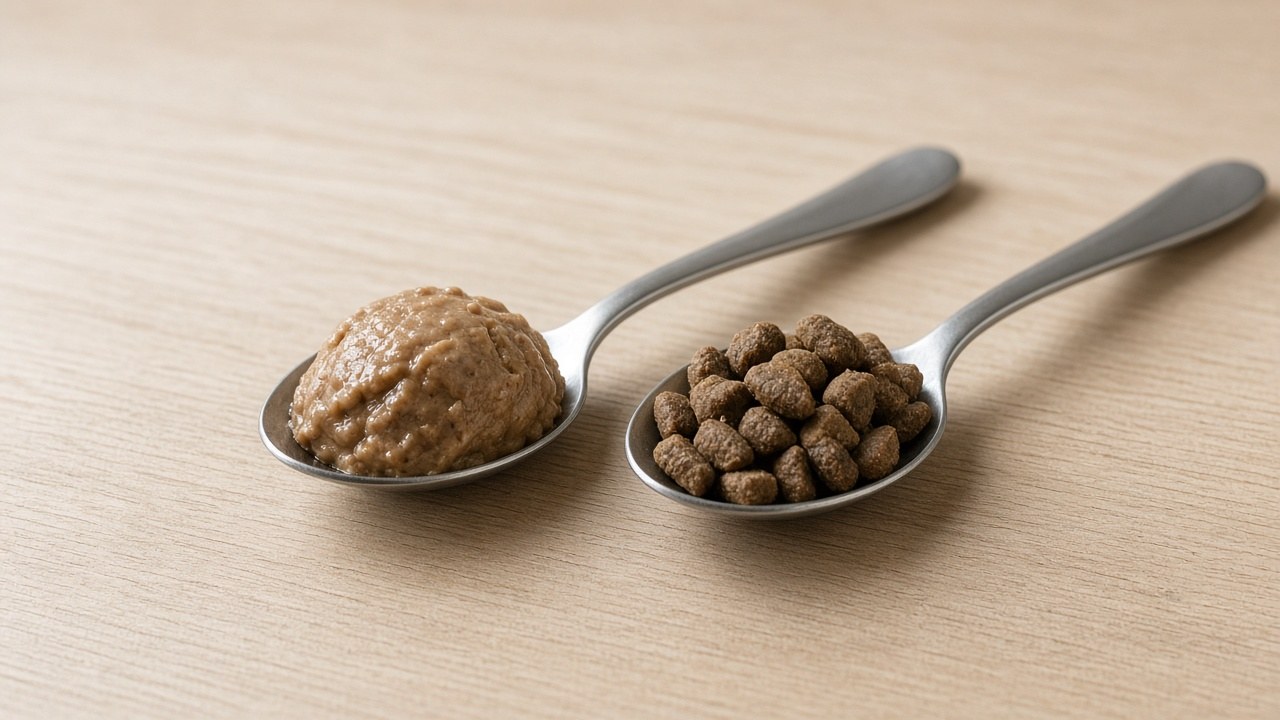
The guaranteed analysis on a pet food label is "as fed," meaning water is included. AAFCO's nutrient profiles use a "dry matter" basis, with the water taken out. The FDA notes that canned pet food is typically 75 to 78 percent moisture and dry food is typically 10 to 12 percent. When moisture differs that much, the FDA says you have to convert to dry matter before you compare.
The FDA's method, in words: subtract the moisture percentage from 100 to get the percent dry matter. Then divide the as fed value by the percent dry matter and multiply by 100.
The FDA's own worked example uses protein, not metals. In it, a canned food listing 12 percent protein at 78 percent moisture works out to about 54.5 percent protein on a dry matter basis, while a dry food listing 37 percent protein at 12 percent moisture works out to about 42 percent. The dry food looks higher on the label and is lower once the water is removed. The FDA wrote this for nutrients, but the same math applies to any concentration, including a metal result.
That's why a wet food can look lower as fed. FDA reviewers flagged this exact problem in a 2011 FDA memo on a published analysis of 58 pet foods (31 dry and 27 wet). They called the failure to correct for moisture differences between wet and dry products one of three critical mistakes in how the results were interpreted. The memo reviewed one analysis. It isn't a regulation.
Some researchers do this step for you. A 2021 study in Scientific Reports reported its pet food results in milligrams per kilogram of dry matter. In a 2017 study, the researchers freeze-dried each food and re-weighed it to measure moisture. So when you read a number, look for "dry matter," "DM," "as fed" or "as is." If a results sheet doesn't say, ask.
Compared to what?
It's tempting to check a pet food number against a limit set for people. In the same 2011 memo, FDA reviewers called that the most critical mistake. The authors had compared estimated pet exposures with reference values set for people. The reviewers said maximum tolerable levels developed from studies in animals, including dogs and cats, were the appropriate comparators for animal diets.
So a comparison is only as good as its yardstick. If a results sheet or a news story says a number is "above the limit," ask whose limit, set for which species, and on what basis (as fed or dry matter). Our post on who regulates heavy metals in pet food covers who does what.
The memo makes one more point. Whether a metal is toxic depends on more than its name. It depends on dose or exposure, and on factors like solubility and valence (the element's chemical state). That's also why iron on a results sheet is a nutrient, not a red flag. Our post asking is iron a heavy metal? explains the difference.
How much your pet eats matters
A concentration tells you how much metal is in a gram of food. Exposure depends on how many grams your pet eats, and that depends on calories and body size.
FDA reviewers called the second critical mistake in the 2011 analysis the lack of any scientific basis for the feeding amounts used. They said daily amounts based on energy needs and the calorie density of each food, or on the feeding directions on the label, would have been more justifiable.
The sources we reviewed did not give owners a formula for this. The principle is enough: two foods with the same number can mean different exposures if one is denser in calories. Body size matters too, which our post on cats vs dogs covers.
Total metal or a specific form?
FDA's multi-element method, for example, measures the total amount of each element, not its form. For arsenic and mercury, the form can matter. FDA's Elemental Analysis Manual lists separate methods for arsenic species and for methylmercury, written for specific foods such as juice, rice and seafood. A total result can't tell you which form was there.
Our post on how pet food is tested for heavy metals explains the lab side, and our post on lead, arsenic, and mercury in cat food explains why form matters for each metal.
Questions to ask about a result
If a brand shares results, or you see numbers in the news, ask:
- Which batch was tested, and when?
- Is the number as fed or dry matter?
- Is it total metal or a specific form?
- Which lab ran it, and with what method?
- What's the reporting limit for each metal?
- What, if anything, is it being compared to?
For a broader checklist on choosing a food, see how to check cat food for heavy metals.
FAQ
Can I compare a wet food result with a dry food result? Only after converting both to dry matter. The FDA says to convert when moisture differs widely, and FDA reviewers called skipping this step a critical mistake in one 2011 analysis.
Can I use limits set for people? FDA reviewers said values set for people are not the right comparison for pets. They said maximum tolerable levels developed from animal studies are the appropriate comparators.
Does a detected result mean the food is harmful? Not on its own. For human food, the FDA says results that detect arsenic don't necessarily mean a food should be avoided. A detected result starts a question about the amount, the form, how much your pet eats and what it's being compared to.
What does ND mean? It usually means the metal was below the lab's reporting limit, not that none was there. Our COA guide explains how to read it alongside the reporting limit.
A note on your pet's health
This article is general information, not veterinary advice. If you have questions about your pet's health or diet, contact your veterinarian.
Want results that come with context?
Heavy Metal Tested is a certification program that helps brands share independent results with owners. Learn how certification works.
Case Studies You May Be Interested In
 Heavy Metals in Your Pet's Water: What Owners Should Know
Your tap and your well are two things you can check yourself.
October 23, 2026
 Who Regulates Heavy Metals in Pet Food?
The FDA, the states, and AAFCO each have a different job. Here is how they fit together.
October 22, 2026