



Heavy Metals in Olive Oil: Answers From the Research
Purity, metals and packaging chemicals are three different tests. Here is what each one tells you.
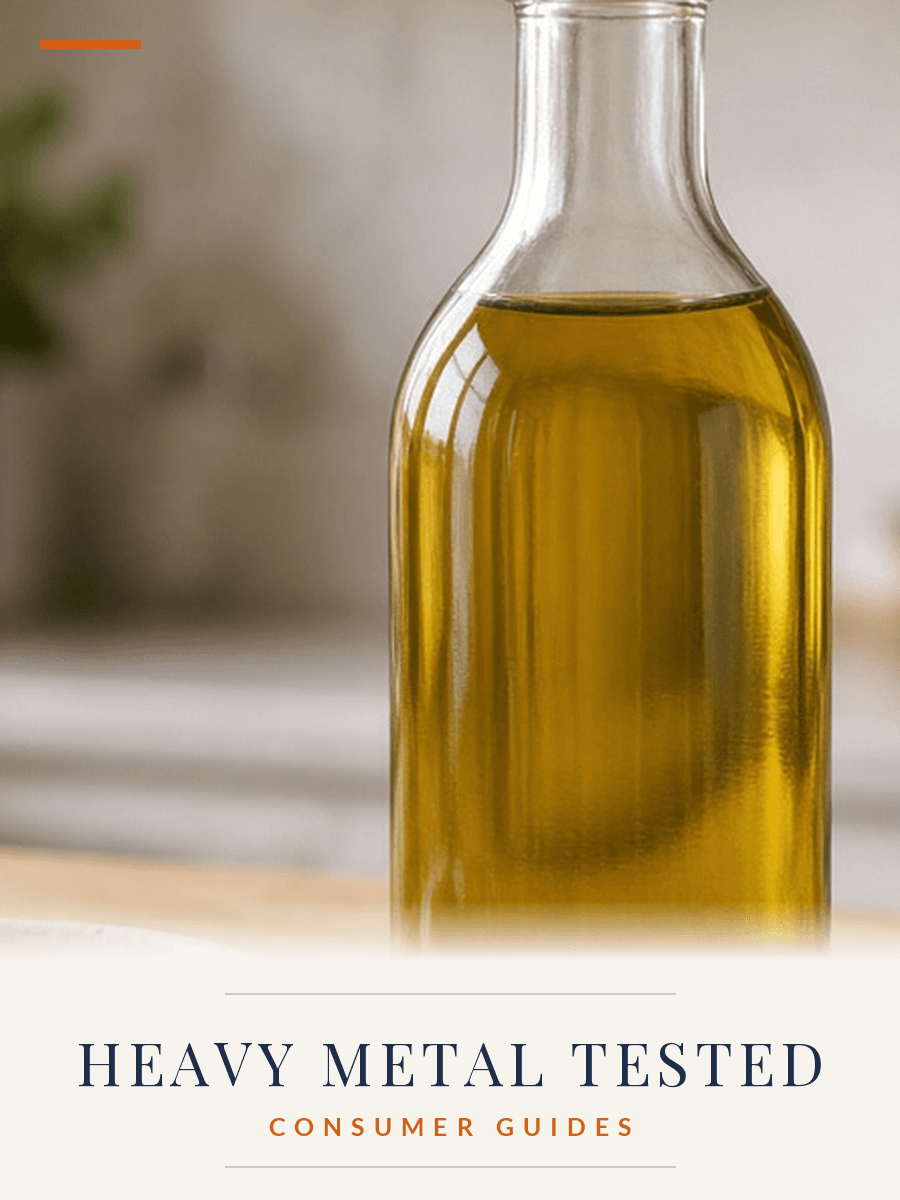
Does olive oil carry lead or other metals? What studies found, where metals come from, how the container matters, and what a purity test can't tell you.

Abstract
Keywords
heavy metals in olive oil, lead in olive oil, cadmium in olive oil, copper in olive oil, olive oil in plastic bottles, phthalates in olive oil, olive oil purity test, EU lead limit olive oil

Online, three olive oil worries get tangled together: Is it fake? Does it carry metals? Is plastic leaching into it? Each one needs a different test, and passing one says nothing about the others. Here is what published research shows for each, one question at a time.
Does olive oil contain heavy metals?
Studies usually find trace amounts. A 2025 study in Toxicology Reports measured 60 oil samples in Iran and found lead and cadmium quantifiable in all of them. Commercial olive oil averaged 13.27 µg/kg lead and 4.14 µg/kg cadmium, all lead results were below Iran's national limit of 80 µg/kg, and the authors' hazard index values were below 1 (Toxicology Reports 2025). A 2025 Spanish market study did not detect arsenic, cadmium, or antimony in any sample (Charfi et al. 2025). Low levels are not the same as no risk, and results describe the oils tested, not every bottle.
Where do metals in olive oil come from?
Soil, air, and farming. The Spanish study lists soil, fertilizers, industrial activity, and nearby highways as sources for metals in olives. It links higher copper to copper fungicides used against olive leaf spot (Charfi et al. 2025).
Tins, bottles, and processing. The same study tested oils sold in glass, PET plastic, tin, porcelain, aluminum, and cardboard containers. Copper was above the 0.1 mg/kg trace limit in several samples, including extra virgin oil in ceramic containers and in tins. One oil, in a ceramic container, measured 0.1 mg/kg lead, the limit itself, which the authors counted as exceeding it (Charfi et al. 2025). The sources we reviewed did not identify which coatings are used inside olive oil tins.
Does copper or iron in olive oil matter?
Copper and iron are not among the most toxic metals, but olive oil standards set trace limits for both: 0.1 mg/kg for copper and 3.0 mg/kg for iron, as cited in the Spanish study. In the Spanish study, iron stayed within the regulatory limit in every sample, while copper ran higher in early-harvest premium oils and some extra virgin oils, which the authors tied to the timing of copper fungicide sprays before harvest (Charfi et al. 2025). They recommended a longer gap between the last copper treatment and harvest. These are quality and contaminant findings for the oils tested, not a health verdict on copper in your kitchen.
Is there a limit for heavy metals in olive oil?
In the European Union, Regulation (EU) 2023/915 sets a maximum of 0.10 mg/kg lead for fats and oils (EUR-Lex). The International Olive Council trade standard sets trace limits for metals such as copper and iron, as cited in the Spanish study (Charfi et al. 2025). Pesticides and microplastics are not part of a heavy metal test. They need separate methods.
Glass, tin, or plastic: does the container matter?
For phthalates, possibly. The Spanish study detected the phthalate DEHP in 6 of 18 oils, at 0.1 to 0.23 mg/kg. Phthalates turned up most often in PET bottles but also in glass, porcelain, and cardboard containers, which the authors linked partly to processing equipment, not just packaging. One oil in a PET bottle exceeded the EU group migration limit for plastics in contact with food (Charfi et al. 2025). Phthalates are not metals, so a heavy metal test will not catch them.
Purity testing vs heavy metal testing
Purity grading asks whether oil is the grade on the label. Labs check acidity, UV absorbance, sensory panel scores, and other markers (Charfi et al. 2025). A metals test uses a method such as ICP-MS to measure elements. An oil can pass one and never be checked for the other.
Label grade and lab grade do not always agree. In the same Spanish study, several oils sold as extra virgin were reclassified as virgin or lampante oil once the researchers ran the chemical and sensory tests, including oils packed in PET, glass, and tin (Charfi et al. 2025). Those oils were not tested for fraud in the legal sense; the point is that only lab grading can confirm a grade.
Home tricks do not settle purity. The UC Davis Olive Center found that the fridge test is not a reliable way to tell whether oil is extra virgin or pure (UC Davis Olive Center). Taste, a peppery throat burn, or a low price cannot prove or disprove authenticity on their own. At the border, FDA Import Alert 99-47 covers economically motivated adulteration, including substituting another oil for olive oil (FDA Import Alert 99-47).
How to read an olive oil lab report
- Who ran the test, and is the lab independent? See third-party tested.
- The method: ICP-MS for metals.
- Units: mg/kg and µg/kg differ by a factor of 1,000.
- Detection limits: "ND" (not detected) means below the lab's limit, not none.
- Lot and date: the result should match your bottle.
Our guide on how to read a heavy metal COA walks through an example.
What a certification mark adds
A published standard plus repeat testing. Heavy Metal Tested publishes an olive oil standard, and our explainer on testing vs certification shows how the two differ. For the wider picture, see heavy metals in food.
FAQ
Does the fridge test prove olive oil is pure? No. The UC Davis Olive Center found refrigeration is not a reliable purity test (UC Davis Olive Center).
Does a throat burn prove olive oil isn't adulterated? No single taste cue proves authenticity; grading relies on lab chemistry plus a trained sensory panel (Charfi et al. 2025).
Is olive oil in plastic bottles a problem? In one 2025 study, phthalates appeared most often in PET-bottled oils, and one exceeded the EU migration limit (Charfi et al. 2025).
Does a plastic bottle add phthalates to olive oil? It can contribute, but the same study also found phthalates in oils sold in glass, porcelain, and cardboard (Charfi et al. 2025).
How do I know if extra virgin olive oil is real? Only lab grading can confirm the grade. Ask for a recent, lot-matched lab report (Charfi et al. 2025).
What is the EU lead limit for olive oil? 0.10 mg/kg for fats and oils (EUR-Lex).
Learn how Heavy Metal Tested certification works.
This article is general information, not medical advice. If you have health concerns, talk to your doctor.
Case Studies You May Be Interested In
 Contaminants in Baby Wipes: Your Questions, Answered
What was measured, what was only alleged, and what you can check yourself.
October 19, 2026
 Heavy Metals in Kitten Food: What New Cat Owners Should Know
Why young animals take in more lead, and what a growth label does and does not tell you.
October 19, 2026