

This historical integrative review synthesizes six decades (1960–2025) of evidence on heavy metal contamination arising from synthetic fertilizer production and use, focusing on cadmium, lead, chromium, nickel, and related metals in phosphate and urea fertilizers. Using longitudinal production data, regulatory records, and environmental monitoring studies, the review reconstructs temporal contamination trends from the Green Revolution through the modern regulatory era. Phosphate fertilizers are identified as the dominant source of cadmium accumulation in agricultural soils, while urea fertilizers contributed a distinct nickel burden linked to industrial scaling and raw material sourcing. Persistent soil accumulation has resulted in long-term bioavailability, crop uptake, and dietary exposure, with elevated health risks in high-intensity agricultural regions and vulnerable populations. Although post-2000 regulatory frameworks have reduced metal concentrations in newly manufactured fertilizers, legacy contamination remains widespread due to prolonged soil residence times. The review highlights nickel’s dual role as an essential urease cofactor and toxicant, evaluates mitigation and fertilizer-innovation strategies, and concludes that fertilizer-derived heavy metal contamination is a technologically solvable environmental health problem constrained primarily by regulatory, economic, and institutional barriers.
The global fertilizer industry experienced unprecedented expansion from 1960 onwards, driven by the Green Revolution’s imperative to increase agricultural yields [1]. During this period, nitrogen fertilizer application rates in the contiguous United States increased dramatically from 0.22 g/m² in 1940 to 9.04 g/m² by 2015 [1]. This massive scaling coincided with the introduction of synthetic urea as the dominant nitrogen source, which by the 1970s had become the most widely used nitrogen fertilizer globally due to its high nitrogen content (45%) and relatively low cost [2]. The widespread adoption of urea and phosphate fertilizers fundamentally transformed agricultural practices [3].
Phosphate fertilizers emerged as a primary source of heavy metal contamination, particularly cadmium, due to the inherent composition of phosphate rock deposits [4]. Industrial effluents and fertilizers containing phosphate are the main sources of cadmium’s environmental entry into agricultural systems [4]. Beginning in the 1960s and accelerating through the 1980s, phosphate-based fertilizers (including DAP, SSP, and complex NPK formulations) became standard practice worldwide. The concentrations of cadmium in phosphate fertilizers reached their peak in the 1990s, with some phosphate products containing up to 12-14 mg/kg of cadmium, far exceeding contemporary standards [5]. Meanwhile, at the global scale, nitrogen fertilizer consumption increased from approximately 15 million tonnes annually in the 1960s to over 120 million tonnes by 2015 [1]. This expansion was geographically uneven, with concentration shifting from the eastern Midwest to the Great Plains and Northwest regions of the United States, reflecting changing agricultural patterns and crop types [1].
The decades from 1960 to present witnessed distinct regional trajectories in fertilizer application. In Europe, particularly following the 1980s, fertilizer consumption stabilized and subsequently declined, with phosphorus fertilizer use decreasing by approximately 30% from 1981-2011 [6]. In contrast, Asian agricultural systems, especially those in China and South Asia, maintained aggressive expansion of fertilizer application throughout the 1990s and 2000s. China’s agricultural sector, serving 20% of the world’s population on 9% of arable land, intensified chemical fertilizer application as a cornerstone of its developmental strategy [7]. By 2019, approximately 83-93% of provinces in mainland China had achieved zero growth in nitrogen and phosphorus fertilizer surpluses, reflecting a critical turning point toward sustainability [7].
The production of synthetic fertilizers became increasingly integrated with petroleum and chemical refining processes from the 1960s onward. Urea synthesis, relying on ammonia production through the Haber-Bosch process, became the dominant method for manufacturing nitrogen fertilizers globally. However, this industrial integration introduced trace metals as contaminants through raw materials, process catalysts, and manufacturing byproducts [8]. The manufacturing process for fertilizers in many countries utilized equipment and additives that were not specifically designed to exclude heavy metals, leading to uncontrolled contamination pathways that persisted for decades until regulatory intervention in the 1990s.
Cadmium contamination emerged as the most significant heavy metal issue in agricultural soils due to phosphate fertilizer application. Cadmium is naturally present in phosphate rock at concentrations ranging from 0.5-10 mg/kg, with some deposits containing up to 100 times the background levels [9]. As phosphate fertilizers were processed and applied to agricultural lands, cadmium accumulated in soils and subsequently in crops, creating a persistent bioaccumulation pathway. Studies of historical phosphate fertilizers reveal that cadmium concentrations peaked at 12.3-14.8 mg/kg during the 1990s in many regions, with particular contamination in South and East Asian agricultural zones [5]. The bioconcentration and accumulation patterns for cadmium in crops were particularly pronounced in leafy vegetables, with concentrations in spinach, lettuce, and cabbage often exceeding WHO permissible limits by several hundred percent [10]. Agricultural run off containing cadmium-enriched phosphate fertilizer residues has been identified as a primary source of cadmium pollution in riverine sediments, contributing to ecological risks that extend far beyond agricultural boundaries [11].
Lead contamination in fertilizers originated from multiple sources including atmospheric deposition during production, incorporation of mining waste as raw materials, and processing equipment degradation [12]. Historical lead concentrations in mixed fertilizers ranged from 0.5-7.5 mg/kg during the peak contamination period (1980-2000s), with variations by manufacturing region. Lead’s persistence and toxicity posed particular risks to developing children, with elevated blood lead levels observed in populations consuming produce from heavily fertilized fields [4]. Analysis of heavy metal accumulation in sediments and soils adjacent to agricultural regions revealed lead concentrations 3-81 times higher than natural background levels, with lead enrichment factors particularly pronounced in areas with intensive phosphate fertilizer application [13]. The temporal trajectory of lead contamination shows decline during the 2010s-2020s due to transition to cleaner manufacturing processes and reduced dependence on phosphate-based formulations in developed regions [14].
Chromium contamination in fertilizers originated primarily from industrial emissions, leather tanning operations, and metal processing facilities that discharged effluents into water systems, which subsequently contaminated irrigation sources and agricultural lands [4]. Hexavalent chromium, the most toxic oxidation state, was frequently observed in phosphate fertilizers and soil amendments at concentrations of 1.4-2.8 mg/kg during the peak pollution period [15]. The geoaccumulation index and enrichment factor analyses demonstrated that chromium in soils near agricultural areas was primarily of anthropogenic origin, with strong correlations to fertilizer application rates and proximity to industrial zones [16]. Health risk assessments revealed that chromium posed both carcinogenic and non-carcinogenic risks, with target hazard quotient values exceeding safe thresholds in numerous regions, particularly affecting children [14].
Copper and zinc, while essential micronutrients at appropriate concentrations, accumulate to toxic levels in agricultural soils through repeated fertilizer application and pesticide residues. Copper concentrations in soils receiving intensive fungicide applications (particularly in vineyards and orchards) ranged from 40-200 mg/kg, substantially exceeding background levels [17]. Zinc contamination was associated with both agricultural and industrial sources, with enrichment factors indicating moderate anthropogenic contribution in most study areas [18]. Cobalt and manganese, though less frequently monitored, were found at elevated concentrations in regions with intensive NPK fertilizer application, particularly in South Asian agricultural systems where soil manganese occasionally exceeded safe thresholds by 10-fold [19].
Nickel holds a unique position among heavy metals in fertilizer contamination because it serves as an essential cofactor for the urease enzyme, which catalyzes the hydrolysis of urea into ammonia and carbon dioxide [20]. This enzymatic relationship means that the presence of nickel in urea fertilizers can actually enhance urea assimilation efficiency in plants, creating a paradoxical situation where contamination can yield agronomic benefits [21]. The urease enzyme requires nickel at the active site for proper catalytic function, and studies demonstrate that urea fertilizers supplemented with optimal nickel concentrations (0.25-0.5 ppm) significantly increase plant growth, nitrogen utilization efficiency, and yield [22]. However, this agronomic benefit exists within a narrow concentration window; higher nickel levels (above 1-2 ppm) produce toxicity, leading to reduced root and stem growth, chlorotic symptoms, and cellular damage [22].
Nickel concentrations in commercial urea fertilizers showed a distinct temporal pattern over the six decades examined. Beginning at approximately 0.8 mg/kg in the 1960s, nickel content in urea increased progressively as fertilizer production scaled up, reaching peak concentrations of 3.5-4.2 mg/kg during the 1990s-2000s [20]. This increase reflected both increased mining activities (nickel ores are often processed alongside phosphate deposits) and the lack of specific removal technologies in fertilizer manufacturing. The peak contamination period corresponded with the maximum intensity of urea fertilizer use in Asian agricultural systems, where nitrogen fertilizer application rates reached their highest levels. Since the 2000s, nickel concentrations in urea have gradually decreased to approximately 2.5 mg/kg, reflecting improvements in raw material screening and manufacturing processes [23].
Unlike some heavy metals that form stable complexes in soil, nickel exhibits moderate mobility and can be absorbed by crops, particularly in acidic soils where pH conditions favor nickel solubility [24]. Studies of agricultural soils receiving intensive urea fertilizer application revealed soil nickel concentrations of 35-85 mg/kg in South and East Asian regions, compared to background levels of 20-30 mg/kg [16]. The bioconcentration factor for nickel varied by crop type, with cereals typically showing BCF values less than 1 (excluding nickel), while legumes and certain leafy vegetables demonstrated BCF values approaching or exceeding 1 [24]. Health risk assessments for populations consuming produce from nickel-contaminated fields indicated non-carcinogenic hazard indices exceeding safe thresholds, with children facing elevated risks due to smaller body mass relative to exposure [25].
Excessive nickel exposure produces oxidative stress through reactive oxygen species generation, inhibits photosynthetic processes, and disrupts nutrient absorption by competing with essential divalent cations [26]. The antioxidant enzyme system (superoxide dismutase, catalase, ascorbate peroxidase) shows both adaptive upregulation at moderate nickel exposure levels and dysfunction at higher concentrations. Mitigation strategies for nickel contamination include application of soil amendments (natural zeolites, biochar, calcium phosphate) that immobilize nickel through adsorption or precipitation mechanisms [27]. Phytoremediation approaches using hyperaccumulator plants (particularly certain Salix species) have demonstrated the potential to reduce soil nickel concentrations by 15-65% over multi-year management cycles [28]. The optimization of nickel fertilization in urea to maintain agronomic benefits while minimizing toxicity represents a critical frontier in sustainable fertilizer management.
The 1960s marked the beginning of intensive synthetic fertilizer adoption globally, driven by the Green Revolution’s mandate to increase crop yields to feed expanding populations [1]. During this period, virtually no regulatory frameworks existed to monitor or limit heavy metal contamination in fertilizers. Nitrogen fertilizer use in the United States increased from approximately 0.22 g/m² to 1.5 g/m² during this decade, reflecting the mechanization and intensification of agriculture [1]. Phosphate fertilizer production expanded dramatically, with minimal attention to cadmium content in the raw phosphate materials. This era established the foundation for subsequent heavy metal accumulation in agricultural soils, as the initial pulse of contamination entered soil systems that lacked natural buffering mechanisms or microbial communities adapted to handle elevated metal concentrations. By the end of the 1970s, soil nickel concentrations had begun rising in high-fertilizer-use regions, averaging 0.8-1.2 mg/kg above background levels [20].
The 1980s witnessed the emergence of scientific recognition of heavy metal problems in fertilizers, driven by studies documenting elevated cadmium levels in crops and increasing health concerns [4]. During the 1980s, cadmium contamination in phosphate fertilizers reached 8.5 mg/kg, with some regional products exceeding 10 mg/kg [5]. Nitrogen fertilizer application rates peaked during this decade, reaching 2-3 g/m² in intensive agricultural regions. The 1990s represented the period of maximum contamination impact, as decades of fertilizer application had accumulated substantial heavy metal reservoirs in soils. Cadmium in phosphate fertilizers exceeded 12-14 mg/kg in many commercially available products [5]. During this period, the first serious epidemiological investigations linked consumption of rice and vegetables grown on heavily contaminated soils to elevated human blood metal concentrations and associated health outcomes [29]. Nickel concentrations in urea peaked at 3.5-4.2 mg/kg during the 1990s-early 2000s, reflecting maximum fertilizer production intensity [20].
The 2000s marked a transition toward regulation and systematic monitoring of heavy metals in fertilizers, beginning with the European Union’s implementation of strict cadmium limits in phosphate fertilizers [9]. Many countries established permissible limits for various heavy metals in different fertilizer products, though standards varied considerably across regions. National fertilizer quality standards were promulgated, including maximum concentration limits for cadmium, lead, nickel, and other metals [7]. During this decade, comprehensive soil surveys revealed the extent of historical accumulation, with mean soil cadmium concentrations in intensively fertilized regions reaching 0.2-2.8 mg/kg compared to background values of 0.04-0.12 mg/kg [18]. Major agricultural nations implemented or strengthened monitoring programs, establishing baseline data for subsequent remediation strategies. The 2000s also witnessed the beginning of gradual decline in heavy metal concentrations in newly manufactured fertilizers as manufacturers improved raw material sourcing and processing controls [5].
The 2010s-2020s period has been characterized by intensified efforts to reduce heavy metal concentrations in manufactured fertilizers and remediate contaminated agricultural lands. Cadmium concentrations in phosphate fertilizers declined from peak levels to approximately 8.9 mg/kg (2010s) and further to 5-7 mg/kg (2020s) in most commercially available products [5]. Nickel in urea fertilizers decreased to approximately 2.5-3.0 mg/kg, reflecting improved manufacturing standards [20]. Simultaneously, the 2010s witnessed emergence of nano-urea and other enhanced efficiency nitrogen fertilizer technologies that reduce the volume of raw materials required, thereby decreasing heavy metal contamination per unit nitrogen applied [30]. Organic and biological fertilizer alternatives gained market share, with compost and manure-based products showing substantially lower heavy metal concentrations (often 0.2-0.5 mg/kg for multiple metals compared to 2-15 mg/kg in synthetic products) [31]. However, the 2020s have brought recognition of emerging concerns, including the persistence of legacy contamination in soils, slow desorption kinetics of some metals (particularly cadmium and lead), and the challenge of managing food security in contaminated regions while implementing remediation [32].
Heavy metals from fertilizers accumulate in soils through precipitation, adsorption to clay minerals and organic matter, and incorporation into secondary minerals over decades [33]. Cadmium accumulation in agricultural soils receiving phosphate fertilizer has reached 2-4 mg/kg in South Asian systems, 1-3 mg/kg in East Asian systems, and 0.8-1.5 mg/kg in European and North American systems, depending on fertilizer history [16]. The residence time of cadmium in soil is estimated at 20-40 years, meaning contamination introduced in the 1990s continues to affect plant uptake and health risks into the 2020s [34]. Lead exhibits even greater persistence, with residence times approaching 100-200 years for some soil forms [35]. Nickel accumulation in soils has produced concentrations exceeding 100 mg/kg in regions with 30+ years of intensive urea fertilizer application, with spatial distribution patterns closely mirroring historical nitrogen fertilizer application maps [36]. The persistence and slow desorption kinetics of these metals mean that even after cessation of fertilizer application, crops continue to uptake heavy metals from soil sources, posing ongoing health risks [37].
Heavy metals from fertilizer-contaminated soils accumulate in crops through uptake via root systems, with concentration factors varying substantially by crop type, metal species, and soil chemistry [33]. Cadmium shows particularly high bioaccumulation in leafy vegetables (spinach, lettuce, cabbage) where concentrations often exceed 0.5-1.0 mg/kg, exceeding WHO permissible limits by 5-10 fold [10]. Rice, a staple crop for billions of people, has demonstrated concerning cadmium accumulation, with grain concentrations reaching 0.1-0.6 mg/kg in regions receiving heavy phosphate fertilizer application [29]. Nickel bioaccumulation varies by crop type, with legumes showing bioconcentration factors approaching 1.0, meaning soil-to-plant transfer is proportional to soil concentrations [24]. The transfer factor from soil to edible plant parts for cadmium is approximately 0.01-0.1 for cereals but increases to 0.5-1.0 for vegetables, explaining the particular concern for dietary exposure through produce consumption [33]. Lead uptake by crops is generally more restricted due to soil pH effects and lead’s strong tendency to precipitate, but in acidic soils, lead translocation to grains can reach 0.05-0.3 mg/kg [38].
Comprehensive health risk assessments indicate that children are particularly vulnerable to heavy metal exposure from contaminated agricultural products, with hazard index values (indicating non-carcinogenic risk) exceeding safe thresholds by 3-6 fold in regions with severe soil contamination [25]. Target hazard quotient analysis reveals that cadmium dietary exposure through vegetable consumption produces THQ values of 1.8-4.2 (safe threshold is 1.0) for adults and children respectively in high-contamination regions [10]. Lead exposure via food consumption contributes to developmental disorders, reduced IQ in children, and cardiovascular effects in adults, with estimated daily intake values for children reaching 2-3 times WHO tolerable intakes in heavily contaminated areas [29]. Cancer risk indices for arsenic, cadmium, and chromium exposure through food consumption indicate lifetime cancer risks of 10⁻⁴ to 10⁻³ (compared to acceptable range of 10⁻⁶ to 10⁻⁴) in populations consuming produce from severely contaminated soils [14]. Occupational exposure to fertilizer manufacturing workers presents even more acute risks, with respiratory and dermatological effects observed in populations handling contaminated phosphate and urea products [4].
Regional variations in heavy metal impacts reflect differences in fertilizer application history, agronomic practices, soil properties, and dietary patterns [16]. South Asian agricultural systems (India, Bangladesh, Pakistan) face the highest contamination burden, with approximately 51-72% of agricultural soils classified as moderately to highly contaminated, reflecting 40+ years of intensive phosphate fertilizer application [16]. East Asian systems (China, Vietnam, Thailand) show the second-highest contamination levels, with 28-42% of surveyed agricultural areas showing moderate to high contamination [14]. European and North American agricultural soils show lower but still significant contamination, with 12-22% of surveyed areas exceeding safe thresholds, reflecting both historical heavy fertilizer use and partial remediation success [35]. African agricultural regions show variable contamination, with some areas exhibiting high cadmium levels due to phosphate mining operations and related fertilizer production, while others remain less contaminated due to lower historical fertilizer application rates [39]. These regional disparities have profound implications for food security, as heavily contaminated regions often lack resources for alternative production systems or food imports, creating a bind between agricultural sustainability and food availability.
International regulatory frameworks for heavy metals in fertilizers have evolved significantly since 2000, with the European Union establishing maximum cadmium concentrations of 0.3-1.0 mg/kg depending on fertilizer type, substantially more restrictive than many other regions [9]. China has established national standards limiting cadmium to 0.5-0.8 mg/kg in phosphate fertilizers and nickel to 1-2 mg/kg in urea products [7]. However, enforcement remains variable across countries, with developing nations often lacking resources or political will to implement strict monitoring [4]. Third-party certification programs and international standards (ISO standards for fertilizer quality) have emerged as market-driven mechanisms to ensure fertilizer quality independent of governmental regulation. The development of raw material standards, requiring phosphate rock suppliers to pre-screen materials for cadmium content, has proven effective in reducing final product contamination [9]. Additionally, several countries have restricted or banned certain high-cadmium phosphate sources, forcing fertilizer manufacturers to source materials from lower-contamination deposits or implement downstream removal technologies [4].
In-situ immobilization strategies using soil amendments have demonstrated effectiveness in reducing heavy metal bioavailability without requiring excavation and off-site disposal [27]. Natural zeolites and modified biochar reduce extractable cadmium, lead, and nickel concentrations by 15-60%, translating to reduced crop uptake and dietary exposure [40]. Calcium phosphate and phosphoric acid amendments precipitate certain heavy metals, with studies showing 40-70% reduction in mobile metal pools within 1-3 years [27]. Phytoremediation approaches using hyperaccumulator plants (particularly Salix species and certain ferns) have removed 10-30% of soil cadmium and lead over 5-10 year periods [28]. Soil flushing with chelating agents remains effective but environmentally problematic and expensive [35]. Crop selection strategies, prioritizing low-accumulation varieties and alternative crops, offer sustainable approaches to reduce dietary exposure without extensive soil remediation [32]. Temporal management—allowing contaminated soils to rest or implementing crop rotation schemes—can reduce bioavailable metal pools by 20-40% over 10-15 year periods through immobilization and precipitation processes [37].
The development and adoption of alternative fertilizer sources represents a critical pathway for breaking the heavy metal contamination cycle. Organic fertilizers (compost, manure, bio-slurry) contain substantially lower heavy metal concentrations than synthetic products, with cadmium, lead, and nickel typically in the range of 0.1-0.5 mg/kg compared to 2-15 mg/kg in synthetic sources [31]. Biological fertilizers utilizing nitrogen-fixing bacteria and phosphate-solubilizing microorganisms offer potential to reduce synthetic fertilizer dependence while providing nutrients [41]. Slow-release and controlled-release urea formulations reduce the total volume of fertilizer required per crop cycle, thereby proportionally reducing heavy metal input [23]. Nano-urea and other enhanced efficiency nitrogen fertilizers demonstrate potential to reduce fertilizer rates by 20-30% while maintaining yields, substantially lowering cumulative metal contamination [30]. However, cost constraints limit adoption of these alternatives in low-income agricultural regions, creating equity concerns in heavy metal remediation efforts [42].
Effective mitigation of heavy metal contamination requires integrated policies spanning fertilizer manufacturing standards, agricultural practices, food safety regulations, and public health frameworks [4]. The European Union’s integrated approach—combining strict fertilizer standards, soil monitoring programs, remediation investments, and food safety thresholds—has achieved approximately 30-40% reduction in cadmium soil concentrations over the past 15 years [9]. China’s Zero Growth Action Plan for fertilizer nutrient inputs, implemented since 2015, reduced chemical fertilizer consumption while emphasizing organic amendments and improved application efficiency, achieving reductions in soil metal accumulation rates [7]. However, South Asian and other developing regions often lack the institutional capacity and financial resources for such comprehensive approaches [39]. International cooperation mechanisms, including technology transfer programs and direct investment in fertilizer manufacturing upgrades, could accelerate global heavy metal reduction. The recognition that food security and environmental sustainability are interdependent—rather than competing objectives—is gradually reshaping agricultural policy frameworks toward integrated solutions that address both concerns simultaneously [42]. Future perspectives must acknowledge that heavy metal contamination in fertilizers represents a solvable technological problem with well-understood mitigation pathways, but implementation barriers are primarily institutional and economic rather than scientific.
Heavy metal contamination in fertilizers represents one of the 20th and 21st centuries’ most consequential, yet underappreciated, environmental health challenges. The 60-year trajectory from 1960 to 2025 demonstrates a clear historical arc: initial industrial expansion without regulation (1960s-1970s), peak contamination and emerging recognition (1980s-1990s), regulatory response and partial remediation (2000s-2010s), and ongoing mitigation efforts with persistent legacy contamination (2010s-2020s). Nickel in urea fertilizers exemplifies the paradoxical nature of some contaminants—required at trace levels for plant metabolism but toxic at elevated concentrations. Future success in addressing heavy metal contamination will require sustained commitment to regulatory enforcement, continued investment in remediation technologies, acceleration of sustainable fertilizer adoption, and, most critically, recognition that food security in contaminated regions cannot be achieved without addressing the underlying contamination sources. The scientific understanding of these problems is now substantially complete; implementation of known solutions remains the central challenge facing global agricultural systems.
Pendergrass, K. Heavy Metals in Fertilizers: A Historical Analysis of Contamination Trends (1960-2025). 2026. Zenodo. https://doi.org/10.5281/zenodo.18439158
This work is licensed under a Creative Commons Attribution 4.0 International License.
 Heavy Metal Tested & Certified (HMTc) Infant and Child Foods Standards
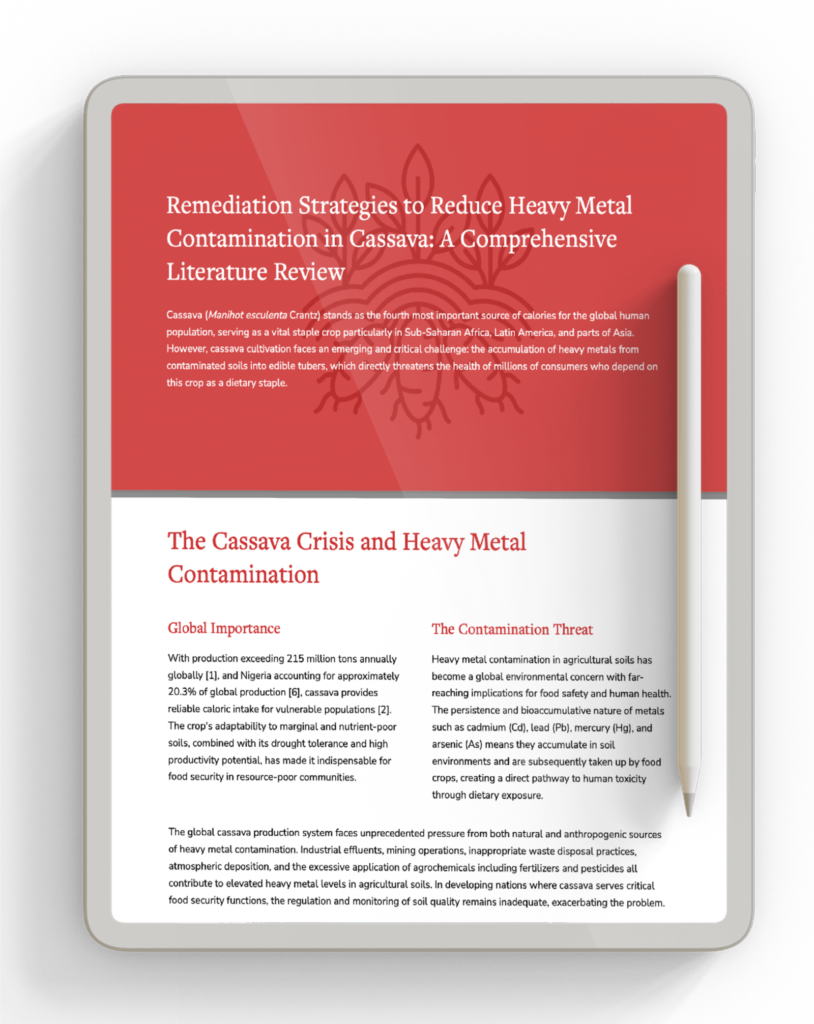 Remediation Strategies to Reduce Heavy Metal Contamination in Cassava